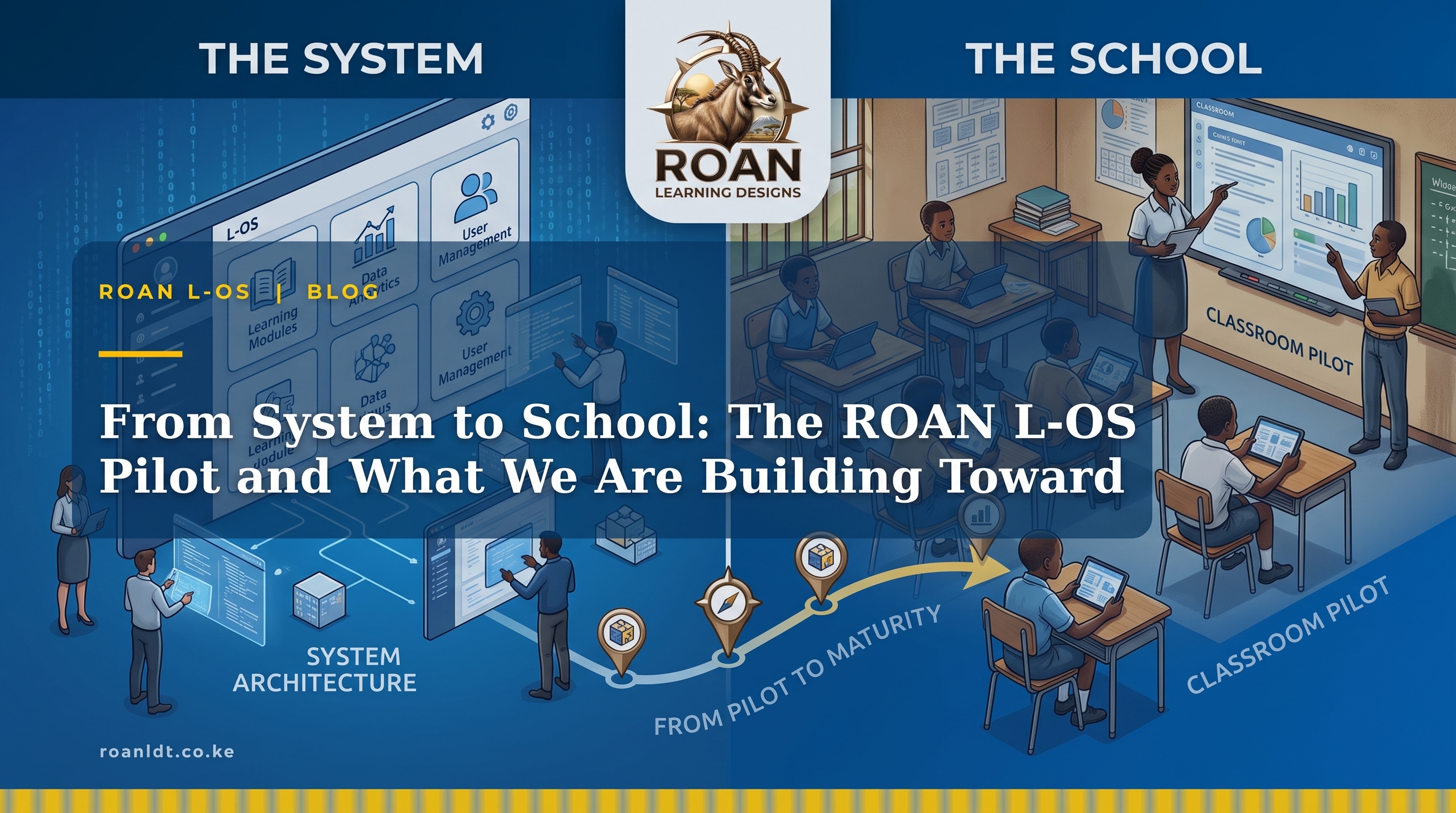
The pilot is the moment a system meets reality. Everything built before it — the Curriculum Graph Engine, the Summative Handshake, the eight dashboards, the six AI integration points, the KNEC compliance pipeline — was built based on a deep reading of Kenya's CBC and a conviction that curriculum-native infrastructure would serve schools better than anything currently available. The pilot tests that conviction against actual teachers, actual learners, and an actual school calendar.
The pilot: what it is and what it is not
ROAN L-OS entered its first school pilot in August 2026. The pilot is structured as an 8-to-9-month live deployment running through the remainder of the academic year — Term 3 2026 into 2027. It is a free-period deployment: schools in the founding pilot cohort are not charged during this phase. The pilot is not a commercial transaction. It is a structured research and validation event — the first sustained test of the platform in a live school environment.
What the pilot is not: it is not a proof of concept. The system was built and tested before the pilot began. It is not a beta test in the sense of shipping unfinished features and iterating based on crashes. The Curriculum Graph Engine, the assessment architecture, the parent dashboard, the teacher command centre, the TPAD self-appraisal module — these are functional before the first school day. The pilot is not about whether the software works. It is about whether the system, in the hands of real educators in a real school context, delivers what it was built to deliver.
This distinction matters because it shapes what we are measuring. We are not measuring bug counts. We are measuring curriculum coverage rates, formative assessment completeness, SBA evidence quality, teacher adoption patterns, parent engagement with the competency portfolio, and the accuracy of the LPW Gate as a diagnostic instrument. These are educational outcomes, not software metrics. The pilot is, in this sense, the first research event in ROAN's life as a platform.
A pilot that only tests whether the software runs is an engineering exercise. A pilot that tests whether the system improves educational outcomes is a research programme. ROAN's pilot is the latter.
What 8 to 9 months covers
An 8-to-9-month pilot running from Term 3 2026 through the 2027 academic year spans three distinct school contexts — a short final term, a full year opening, and the transition into Term 2. This structure is deliberate. A single-term pilot would tell us how the platform performs when teachers are at their most prepared and students are at the start of a learning cycle. A multi-term pilot tells us something more important: how the platform performs across the full lifecycle of a school year, including the transitions between terms where cumulative assessment data compounds, remedial pathways activate, and the LPW delivery record from one term feeds the gap analysis for the next.
The pilot phase is structured around four questions that the deployment data will answer.
Coverage integrity. Does the curriculum graph engine's lesson distribution match what teachers are actually able to deliver in a term? The 10:11:6 teaching-week model we use to distribute sub-strands across the year is ROAN's own model derived from the 13:14:9 calendar structure. The pilot will validate whether our model's assumptions about instructional time hold across a real school's calendar, including assemblies, sports days, national holidays, and the accumulated disruptions that any school year contains.
Assessment completeness. Do teachers complete formative assessments at the sub-strand level with enough regularity and granularity that the Summative Handshake can generate meaningful KNEC-compliant evidence? We designed the assessment interface around minimising the time cost of an individual observation. The pilot will tell us whether we got that design right.
Parent engagement. Does the parent-student portal — with its competency portfolio, gap-flagging, and M-Pesa-enabled remedial content access — change how parents engage with their children's learning? This is the question we most want answered and least know the answer to before the pilot begins. The platform was designed on the assumption that parents want granular competency information, not summary grades. The pilot tests that assumption.
Teacher experience. How does the TPAD self-appraisal module, the lesson delivery recording, and the integration between daily teaching and assessment evidence change a teacher's working week? The platform was designed to reduce administrative burden while increasing evidence quality. We will know within two terms whether we achieved both, or only one.
NVIDIA Inception: scaling intelligence
In 2026, ROAN was accepted into the NVIDIA Inception Program — NVIDIA's global accelerator for AI startups. The acceptance matters for what it signals as much as for what it provides. NVIDIA's technical reviewers look at what a company is actually building, not what it claims to be building. Acceptance is a form of peer review: the AI infrastructure decisions embedded in ROAN's architecture — graph-based curriculum representation, constrained generative AI, curriculum-aware content guardrails — were evaluated by people who understand the engineering beneath them.
The practical value of Inception for the pilot phase is threefold. First, access to compute resources and cloud infrastructure credits reduces the cost ceiling on what the pilot can explore technically. Running the Curriculum Graph Engine, six Claude AI integration points, the Summative Handshake pipeline, and the Bridge event bus simultaneously across a live school generates real-time data that benefits from accelerated processing. Second, access to NVIDIA Deep Learning Institute training resources allows the ROAN team to build fluency in NVIDIA's AI tooling — RAPIDS for graph analytics, cuOpt for constraint optimisation problems adjacent to timetabling and scheduling — at exactly the stage when the pilot data will reveal whether these capabilities should enter the platform's roadmap. Third, Capital Connect network access: NVIDIA's Inception program connects startups with investors at the moment when they have a live pilot and real data to show. The timing is not accidental.
Looking further ahead, NVIDIA's tooling roadmap aligns directly with where ROAN intends to go after the pilot. The Curriculum Graph Engine currently runs on Neo4j's community graph database. At the 50-school threshold — where the platform's planned Python-to-Go migration also triggers — NVIDIA's RAPIDS cuGraph library offers GPU-accelerated graph analytics at a scale that Neo4j's community edition cannot match. The pilot is the bridge between the architecture we have built and the architecture the platform will need at national scale.
NVIDIA's Inception acceptance is a technical endorsement at the architecture level. It is the kind of validation that opens doors — with investors, with institutions, and with the engineers who will eventually build on top of what we have started.
The pilot as a research foundation
One of the things the pilot will generate that no amount of pre-pilot development can is a body of real deployment data — curriculum coverage rates, assessment completeness, teacher adoption patterns, parent engagement behaviour, and the performance of the LPW Gate as a diagnostic instrument across a live school year. This data has value beyond product iteration. It is the raw material for the first scholarly body of work on curriculum-native learning platform architecture in Africa.
There is currently no peer-reviewed literature on curriculum-native systems. The concept has not been formally defined in academic journals. The architectural distinction between curriculum-adapted and curriculum-native platforms has not been theorised or empirically tested. This is, in part, why we have been writing these posts — to begin establishing the conceptual vocabulary in public. But blog posts are not the same as research papers, and research papers are not the same as a validated body of findings grounded in real deployment data.
The pilot changes that. Eight months of structured deployment — with teachers assessing against specific learning outcomes, with the curriculum graph driving lesson sequencing, with the Summative Handshake generating auditable SBA evidence — produces the kind of dataset that enables serious scholarly inquiry. How does formative assessment completeness affect summative evidence quality? Does curriculum-native lesson scheduling change teacher planning behaviour? Does the LPW Gate function as a reliable diagnostic instrument for identifying genuine learning gaps versus incomplete instruction? These are questions that the pilot will position us — and any research partner who works alongside us — to answer with data rather than theory.
We are entering the pilot with a deliberate intention to document what we observe rigorously enough that it can form the foundation of future academic collaboration. The pilot is not only a validation event for ROAN L-OS. It is the groundwork for building scholarly authority in a field that does not yet have a literature. The schools, teachers, and learners participating in this phase are contributing to something larger than a product trial — they are contributing to the first empirical record of what curriculum-native infrastructure actually does in an African classroom.
The pilot generates data that no architecture document can. It is the beginning of the evidence base for a field that does not yet have one.
What scaling means at this stage
The pilot is not primarily about proving that ROAN L-OS works. It is about proving that ROAN L-OS works well enough to scale, and identifying the specific points where scaling will require changes to the architecture, the product, the pricing model, or the go-to-market approach.
Scaling a curriculum-native Learning Operating System in Kenya is not the same as scaling a generic SaaS product. It is not primarily a distribution problem — getting more schools to sign up. It is an integrity problem: ensuring that as more schools join the platform, the assessment evidence they generate remains accurate, the curriculum graph remains the single source of truth, and the KNEC compliance pipeline continues to produce export records that the national examination body trusts.
The NVIDIA tooling gives us a path to technical scale: GPU-accelerated graph analytics at 50+ schools, optimised scheduling algorithms for timetabling and curriculum distribution, and the inference infrastructure needed to serve six AI integration points at volume. The pilot's deployment data gives us a path to evidential scale: documented findings that support KICD's confidence in the system, KNEC's trust in the evidence architecture, and TSC's willingness to accept TPAD appraisal records generated through the platform. Technical scale and evidential scale are both necessary. Neither is sufficient alone.
The pilot generates both. Eight months of live deployment data is enough to establish the operational baseline. Eight months of rigorous documentation is enough to begin answering the first wave of institutional questions — and to lay the groundwork for the scholarly collaboration that those answers will eventually require. And eight months of building the relationship between a school, an AI infrastructure partner, and the national curriculum system is enough to understand what the founding cohort of ROAN L-OS schools will look like, and what it will take to grow from one school to many.
The pilot is not a destination. It is the data collection event that tells us where the destination actually is.
What we are watching for
We entered the pilot with three specific hypotheses that the 8-month deployment will either confirm or complicate.
Hypothesis one: the LPW Gate changes teacher planning behaviour. The LPW Gate locks remedial scheduling until 100% of allocated lessons for a subject-class pair have been delivered. Our hypothesis is that this constraint — which forces teachers to complete instruction before accessing remediation — will change how teachers plan their terms. Specifically, we expect to see teachers front-load lesson delivery in Terms 1 and 2 to ensure the remedial window opens in time for Term 3 intervention. If this happens, the Gate is functioning as designed. If teachers find workarounds — marking lessons as delivered before they are — we have a data integrity problem that the pilot will surface early.
Hypothesis two: parent engagement with the competency portfolio is higher than with grade-based reporting. This is the assumption the entire parent-student portal is built on. It is also the assumption we have the least evidence for before the pilot. We will measure it by comparing login frequency, time-on-platform, and M-Pesa intervention purchase rates against what schools in comparable demographics report for grade-based reporting engagement. If engagement is not higher, the portal design needs to change.
Hypothesis three: the Summative Handshake generates SBA evidence that is consistently structured enough for KNEC export without manual correction. This is the reliability test of the evidence architecture. If teachers' sealed observations consistently produce KNEC-compliant export records without intervention, the system is ready for multi-school deployment. If the export records require frequent manual correction — because teachers are assessing at the wrong level of granularity, or because the interface is not guiding them clearly enough — we have an interface problem, not an architecture problem. The pilot will tell us which.
By the time the 8-month pilot concludes, we will have answers. Not complete answers — no single-site pilot produces those. But enough to build the founding cohort brief with confidence, to approach the next round of school conversations with data rather than theory, and to know which parts of the system are ready and which parts still need to earn their place.

ROAN Learning Designs
Building Kenya's sovereign learning operating system — CBC-native, curriculum-first infrastructure for every learner on the continent.
Get in touch