There is a difference between building a house on foundations and bolting walls onto a tent. From the outside, at a distance, both provide shelter. Both have walls. Both have a roof. But when the storm arrives — when the government changes the assessment framework, when a new education tier is introduced, when you need to answer a question the original structure was never designed for — one holds and the other does not. The difference between curriculum-adapted and curriculum-native EdTech is the difference between these two structures. It is the single most important architectural decision ROAN made, and it determines what the platform can and cannot do at every layer.
What curriculum-adapted means
Most education technology platforms in the world are curriculum-adapted. This is not an insult. It is an architectural description. A curriculum-adapted platform is built as a generic system — a content management engine, an assessment tracker, a gradebook — and then configured to work with a particular curriculum. The curriculum is bolted on after the fact. It exists as metadata: tags, labels, dropdown menus, mapping tables that connect a piece of content or an assessment to a curriculum standard.
The platform's core data model does not know what a curriculum is. It knows what a course is, what a lesson is, what an assignment is, what a grade is. It can store a PDF of the national curriculum and let administrators tag their content against it. But the curriculum's internal logic — which outcomes depend on which, how assessment ratios shift between education tiers, how lesson allocations are computed from national specifications, how a single structural flag should reconfigure fourteen interface components — lives outside the system.
This is the tent. The tent can be moved, reconfigured, and re-skinned. It is flexible. It accommodates many curricula by design. But it accommodates none of them deeply. When Kenya's KICD publishes a curriculum reform, a curriculum-adapted platform responds with a maintenance sprint: new tags, new mapping tables, new configuration values. The work is manual, error-prone, and must be repeated for every school on the platform.
A curriculum-adapted platform knows about the curriculum the way a tourist knows about a city — from the map, not from the streets.
What curriculum-native means
A curriculum-native platform inverts the relationship. The curriculum is not metadata. It is the database schema. It is not a tag on the content. It is the structure the content exists within. Every table, every query, every API endpoint, every dashboard component derives its behaviour from the curriculum graph.
In ROAN L-OS, the Curriculum Graph Engine encodes the entire KICD curriculum from PP1 through Grade 12 as a directed acyclic graph. Every learning outcome is a node. Every strand and sub-strand is a node. The edges between them carry meaning: prerequisite relationships, co-requisite clusters, assessment weight distributions derived from KNEC specifications. The graph knows that Early Years Education uses a four-level competency scale while Senior Secondary uses an eight-level scale. It knows that Term 1 has ten teaching weeks, Term 2 has eleven, and Term 3 has six. It knows that Mathematics at Junior Secondary gets five lessons per week while Creative Arts gets five. These are not configuration values. They are properties of the graph.
This is the house. The foundation is poured first. The walls go up on the foundation. The plumbing runs through the walls. Every room exists in structural relationship to every other room. You cannot remove the foundation without bringing down the house — but you would never want to, because the foundation is what makes the house habitable.
Why the difference matters: four things a tent cannot do
The distinction between curriculum-adapted and curriculum-native is not philosophical. It produces measurable differences in what the platform can and cannot do. Here are five capabilities that require a curriculum-native architecture and cannot be replicated by configuration.
One: Tier-aware assessment ratios. Kenya's CBC defines different assessment weightings for each education tier. Upper Primary operates at 60% SBA and 40% summative. Junior Secondary operates at 20% SBA Window 1, 20% SBA Window 2, and 60% summative. Senior Secondary operates at 40% SBA and 60% summative, with the SBA component itself split 30/70 between formative and summative internally. In a curriculum-native system, these ratios are properties of the curriculum graph. When a teacher generates an assessment, the system traverses the graph, identifies the tier, and applies the correct weighting. No dropdown. No configuration table. No possibility of human error. A curriculum-adapted system must store these ratios as configuration values — and every school administrator must set them correctly.
Two: The isSSS flag. When a student or teacher is in Senior Secondary context, a single runtime flag — isSSS — reconfigures fourteen interface components simultaneously. The grading scale shifts from four-level to eight-level. Subject validation enforces 571 valid combinations across three pathways and seven tracks. The timetable structure changes. The CGE code format changes. SBA evidence requirements change. Elective combination enforcement activates. This is not a mode toggle that a developer wired up. It is the graph expressing the structural reality that Senior Secondary is a fundamentally different educational tier. A curriculum-adapted system would need fourteen separate configuration rules, each maintained independently, each capable of drifting out of sync.
Three: Gap-only AI content generation. ROAN's AI integrations are locked to identified learning gaps. If a student has demonstrated competency in a sub-strand, the system will not generate remedial content for that sub-strand — regardless of who asks. The AI does not decide this. The curriculum graph decides it. The graph knows which outcomes have been assessed, at what competency level, and whether a gap exists. The AI receives only the gap data and curriculum structure. No personal learner data crosses the API boundary. A curriculum-adapted system cannot enforce this guardrail structurally — it would need to check a separate gap database, maintained independently of the content generation pipeline, with no guarantee of consistency.
Four: Proportional term distribution. The Kenyan school calendar is asymmetric: ten weeks in Term 1, eleven in Term 2, six in Term 3. The CGE distribution engine reads the KICD-specified lessons per week for each subject, computes total annual capacity, and distributes sub-strands proportionally across the 10:11:6 ratio using largest-remainder rounding. The outputs — lessons allocated per sub-strand, term targets — are engine computations. They never appear in any upload template because they are not data to be entered by a human. They are answers the graph produces. A curriculum-adapted system would require a school administrator to enter these values manually — and the values would differ for every subject at every grade level.
The tent in the storm
Kenya's CBC is one of the most ambitious curriculum reforms undertaken anywhere in the world. It replaced a two-tier system with a four-tier system. It introduced competency-based assessment at every level. It created Senior Secondary pathways that did not previously exist. And it is still evolving — KICD continues to refine curriculum designs, KNEC continues to develop assessment frameworks, and schools continue to adapt.
Every change is a storm. When the assessment ratio changes, every platform must respond. When a new subject combination is approved for Senior Secondary, every platform must update. When KICD revises the lessons-per-week allocation for a subject, every platform must recalculate.
A curriculum-adapted platform responds to each change with a maintenance sprint. A curriculum-native platform responds by updating the graph. The update propagates automatically to every dashboard, every assessment, every AI generation, every report. One change. One place. Every downstream feature inherits the new behaviour.
Curriculum-adapted platforms are built for a curriculum that holds still. Curriculum-native platforms are built for a curriculum that is alive.
Why ROAN chose foundations over fabric
We did not make this decision because curriculum-native architecture is more impressive on a pitch deck. We made it because we tried the alternative and it failed. In the early stages of development, we attempted to support Kenya's CBC using a flexible, configurable platform architecture — the tent. It worked for simple cases. It broke the moment we encountered tier-specific assessment ratios, Senior Secondary pathway validation, asymmetric term distribution, and the requirement that AI content generation be locked to curriculum-identified gaps.
Each of these requirements, individually, could have been handled with a configuration hack. Together, they formed a web of interdependencies that no configuration layer could manage reliably. The only solution was to make the curriculum the foundation — not a layer on top of the platform, but the layer underneath it.
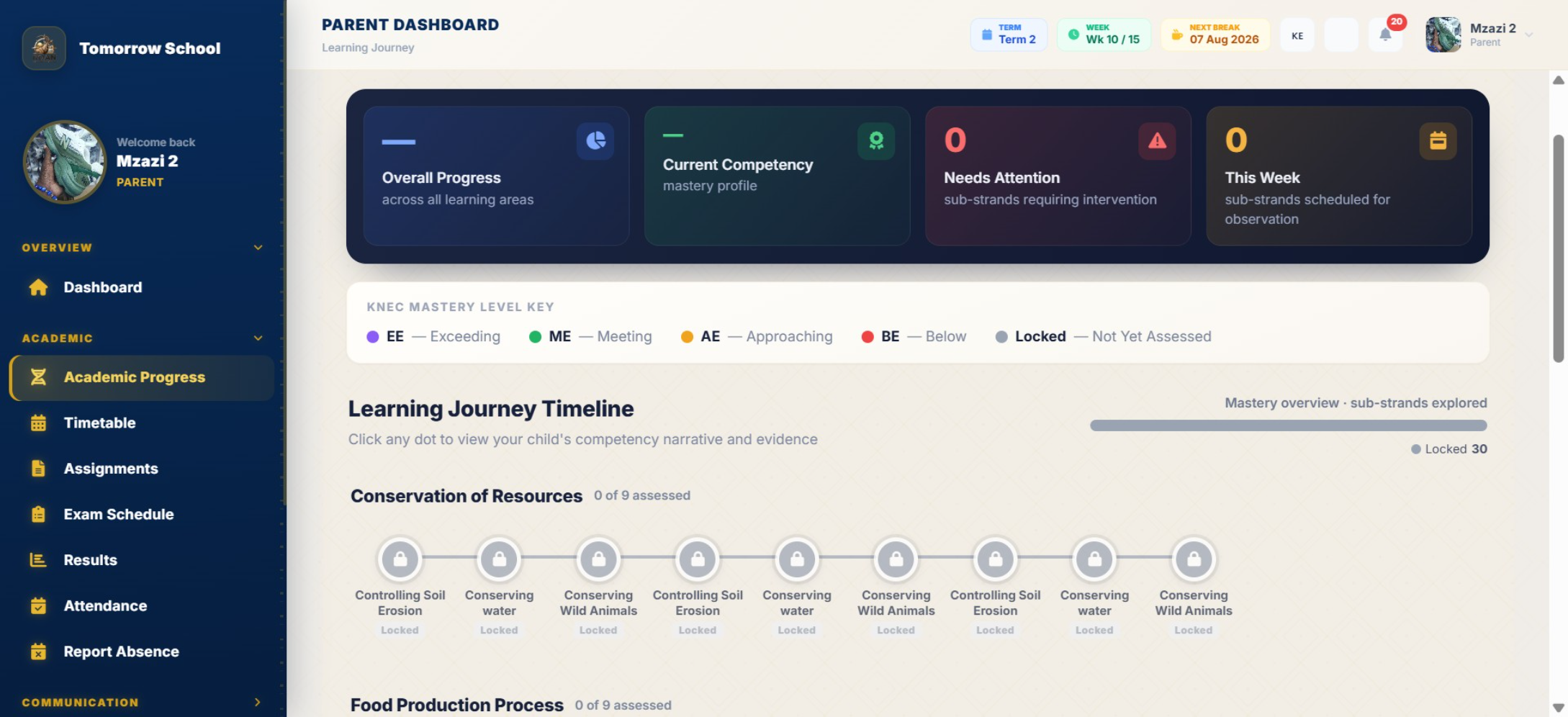
That decision cost us months. It meant rebuilding the data model. It meant designing the Curriculum Graph Engine from scratch. It meant accepting that our platform would serve one curriculum deeply rather than many curricula superficially. But it also meant that every feature we built afterward — assessment, scheduling, AI generation, parent dashboards, publisher tools, institutional reporting — inherited curriculum awareness automatically. We did not have to teach each feature what the CBC looks like. The graph already knew.
The papers on curriculum-native architecture have not been written. The distinction between curriculum-adapted and curriculum-native has not been formalised in academic literature. We are defining it here because it is the most consequential technical decision in education infrastructure — and because every school implementing a competency-based curriculum deserves a platform built on foundations, not fabric.
ROAN Learning Designs
Building Kenya's sovereign learning operating system — CBC-native, curriculum-first infrastructure for every learner on the continent.
Get in touch